Showing posts with label Hopkins. Show all posts

Saturday, February 5, 2011

Dr. Jekyll and Mr. Hyde (1931)


Horrible consequences take place when we let the inner animal out of its cage!

Mamoulian set new bounds by using several advanced camera and editing tricks never before seen in filmmaking beginning with the use of a subjective camera (the first in film history) so that the audience would experience what it was like to be in Jekyll’s shoes and, more importantly, so they would know what it was like to turn into Hyde- essentially get in touch with their animal selves. The audience also got to experience “wipes”, a transitional technique in which one shot is "wiped off" the screen by another shot reminding the audience of good and evil. Interesting close up shots were used as well, particularly horrifying is when Ivy first experiences Hyde’s power over her. There is also an interesting super-imposed image of Ivy’s leg swinging to and fro much like a pendulum, a ticking down of time, a reminder that temptation is about to get the better of Jekyll. But the most significant camera usage comes when Jekyll transforms himself into Hyde. Despite today’s standards of filmmaking, I was extremely impressed with Mamoulian’s magic which boiled down to colored filters and carefully placed make-up. March too, it should be noted, helped greatly with these transformations. What he does with his face, the ticks and twitches he gives Hyde are ingenious.
Mamoulian’s take on Stevenson’s classic novel was also advanced.


Unlike Stevenson’s novel which is portrayed more closely by Barrymore’s Jekyll where Jekyll is corrupted by Muriel’s father Mr. Carew who thinks Jekyll too virtuous, Mamoulian’s Jekyll cites the conflict of between the spiritual man and the animal within him, the battle between good and evil. This Jekyll believes there is an animal caged in all men and he sets about to let him free. Mamoulian also introduces two women- one bad, Ivy and one good, Muriel to help parallel the two sides of Jekyll's nature. This Jekyll is also a pre-code delight, basically boiling down to him being of a lustful nature, but binded by the restrictions of a repressed gentleman in a Victorian society. He can no longer wait for Muriel, his virtuous fiance, he must marry her soon. When admonished by his friend Lanion for his impatience, Jekyll replies, “I am not marrying to be sober, I am marrying to be drunk. Drunk with love and life and experimenting.” Indeed!

It took Mamoulian, a lot of time to convince both Paramount and March to play the dual role of Dr. Jekyll and Mr. Hyde in the first talkie version of the Robert Louis Stevenson novel. But Mamoulian was convinced that though anyone could play Hyde, only March could perfect the dual role. Imagine! Fredric March, Hollywood’s darling and the dreamy matinee idol playing the horrendous monster Hyde! As history shows, Mamoulian was correct and an Academy Award that March surely thought he would not be in the running for when he began filming was awarded with the special distinction that this was the first time and actor in a horror film won. A distinction that lasted until 1991’s Silence of the Lambs was awarded best picture, and garnering Foster and Hopkins with Oscars for their performances.


March surely deserved the Academy Award. I consider this film his best performance out of all the films I have seen him in thus far. His Jekyll is so very moving, culminating into the heart-wrenching scene where he must give Muriel up. This is divinely paralleled by his portrayal of Hyde who goes from a young playful ape-like man to a horribly savage beast (another interesting technique of Mamoulian’s who caught a lot of flack about March’s portrayal being too funny. However Mamoulian wanted him to be funny, at least at first.)


Miriam Hopkins, who oddly enough was not even nominated for an Academy Award, is also notably wonderful in this film. She is given three great scenes and plays them magnificently. When she first meets Jekyll, her ill-concealed lust for him is entertaining. Another pre-code delight as she places Jekyll’s hands on her body, performs a strip tease, and brings him down to her level (on many levels) for a kiss. In contrast, her visible terror of Hyde as he taunts her and demands emotion she cannot give is so realistic and tangible it’s as if you are right there in the room with her. All this culminates into her own heart breaking scene where she ironically begs Jekyll to save her from Hyde, offering all of herself to him.


If you have not gotten a chance to see this wonderful film which has thankfully been restored to its unedited version, do so, it is a truly amazing cinematic piece for its time.


Oscar trivia:

Rouben Mamoulian though very deserving, at the very least for this film, was never nominated for an Academy Award though he directed films like Dr. Jekyll and Mr. Hyde and Becky Sharp that garnered nominations for March and Hopkins.

Miriam Hopkins was only nominated once in her career for Best Actress for the film Becky Sharp.


Fredric March was nominated four times for Best Actor and won twice. Once for Dr. Jekyll and Mr. Hyde in which he tied with Wallace Beery for The Champ and for The Best Years of Our Lives. He lost out on his nominations for Best Actor for The Royal Family of Broadway and A Star is Born.

Monday, January 3, 2011

The Lion in Winter (1968)

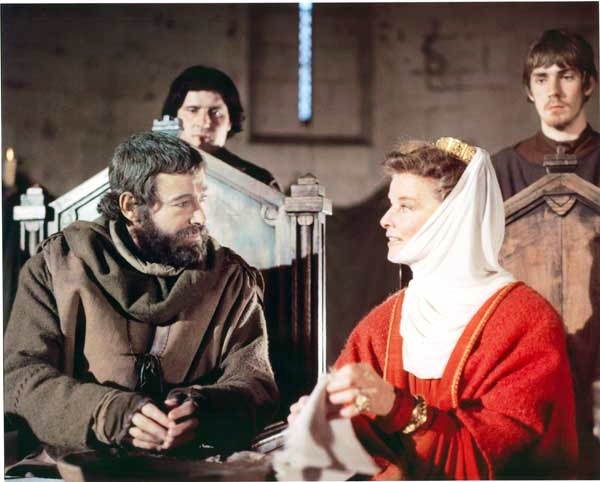
The Lion in Winter concerns the dysfunctional family of King Henry (Peter O’Toole) and his wife Eleanor of Aquitaine (Katharine Hepburn). Eleanor, who has been kept imprisoned in a tower for the past ten years due to her efforts in raising civil war against Henry in the past, has been let out for Christmastide and the visit of King Philip II of France (Timothy Dalton). Due to the death of their heir apparent Henry, King Henry must name a new heir from their three sons, Richard, Geoffrey, and the youngest, John. All of who are vying for the privilege of being the next king. Eleanor favors Richard (Anthony Hopkins), while Henry favors John (Nigel Terry). Poor Geoffrey (John Castle) isn’t considered at all. To complicate matters, the young Phillip is visiting expressly to remind Henry of a treaty he signed many years earlier with his father King Louis (who was once Eleanor’s husband until their marriage was annulled), promising Philip’s sister Alais’ (Jane Merrow) hand in marriage to Henry’s heir. However, Alais has been Henry’s mistress for the past few years, and Henry secretly hopes to marry her off to John but keep her for himself.


 When it becomes apparent that Eleanor and Henry will spend Christmas trying to outmaneuver, scheme and plot for their choices of heir with no consideration for him, Geoffrey begins to plot with King Phillip, planning a war against his father. A plot that will eventually include his younger brother John who ignorantly believes his father when he announces to Eleanor that Richard will be king. Not seeing it for the sneaky maneuver it really is, Henry will discover Geoffrey and John’s plan. Combined with his sudden knowledge that Richard prefers men to women, Henry realizes that he wants none of his sons to be the next king. After much consideration, he decides to annul Eleanor, marry Alais and make new heirs. A tricky maneuver Eleanor immediately pounces on due to Henry’s age, his inability to will Alais to bare sons, and even then, his inability to protect said sons Richard, Geoffrey, and John who would naturally fight for the throne.


The Lion in Winter explores many themes beyond the dysfunctional family such as political maneuvering, love loss, aging, death, and of course, inheritance. Filled with much plotting and scheming, it’s difficult to believe what and who is true or false.


Hepburn, in what I consider to be her best role yet (this is no Hepburn of the 30’s and 40’s here), elicits such sympathy as the independent yet pitiful Eleanor, a woman who still loves her husband but only arouses his passion through anger and insult. Though she manages to tolerate seeing Henry with Alais (a girl she had a hand in raising), her jealousy is translated through civil war against her husband using her son’s rivalry to aid them in committing treason and even possibly, murder.

O’Toole, who continues his reign as Henry II from the earlier film Becket (1964) does so masterfully. In Becket, his Henry is portrayed over a number of years, he is young, impetuous, a serious womanizer, warrior, and lover of all things fun. However, by the end of the film, some of that fire has gone out of him with the death of Becket. In The Lion in Winter, he is much tamer but still has the strength to roar when the situation calls for it- mostly when Eleanor is around. Like when she confesses she slept with Becket and his father. She knows how to goad him, in a way trying to prove there is still love or passion there. There is, making it all the more heartbreaking that they cannot get along better. They have been at war so long, that neither knows a better way to communicate beyond taunts and insults.


Beyond O’Toole and Hepburn, The Lion in Winter also features great acting from newcomers Anthony Hopkins and my long-time crush, the ever-handsome Timothy Dalton (who made a perfectly wonderful 007, in my book). I highly recommend this film. The dialogue alone is quite a treat!

Tonight on TCM!
Featuring director Josef von Sternberg!

Wednesday, September 22, 2010

Pre-Code Dip: Design for Living (1933)


Design for Living was the first vintage film I have seen that blatantly uses the word sex and refers to it as such. The premise is simple- two men are in love with a woman who is in love with both of them.

Gilda: A thing happened to me that usually happens to men. You see, a man can meet two, three or four women and fall in love with all of them, and then, by a process of interesting elimination, he is able to decide which he prefers. But a woman must decide purely on instinct, guesswork, if she wants to be considered nice.

They're all American artists living in Paris. Gilda (Miriam Hopkins) takes it upon herself to nurture Tom (Fredric March) with his playwriting and George (Gary Cooper) with his painting. They will all live together...platonically.

Gilda: Boys, it's the only thing we can do. Let's forget sex.

Gilda does such a good job that Tom lands a job directing his play in London leaving George and Gilda alone. Inevitably, George and Gilda resume their lust for one another as a way to comfort themselves now that Tom is no longer around. Tom is given the news via a letter and despairingly wishes them the best of luck. Months go by and Tom decides to visit George in New York. But Gilda has made him a success as well and he is on the road when Tom visits. Gilda greets him and inevitably their lust resumes as George is not currently around. Thinking to have two more days with Tom before George returns, both she and Tom are suprised when George comes home early and discovers what's happened. Gilda decides to leave them both and Tom and George promptly get drunk. A hilarious scene in itself.
Gilda then marries Max Plunkett (Edward Everett Horton), not for love but for security. That security soon turns to frustration and Gilda is saved in the nick of time by the sudden return of George and Tom who whisk her away after she tells Max she will divorce him.


Design for Living is the film they made me fall in love with Fredric March. The best scene in the film is when they rescue Gilda and completely flummox Max. Animal, vegetable, or mineral? Apparently this version of the film was whitewashed. If that's the case, the hedonist in me hopes that the unedited version is floating around somewhere.
This film is fantastic! There are some real laugh-out-loud moments and the pairing of Cooper and March is genius. Miriam Hopkins is as gorgeous as ever and it was refreshing to see her play such an unwitting vixen, a role I had not seen her do before. This pre-code delight is my favorite thus far and I highly recommend it.

Monday, September 7, 2009

Trouble In Paradise (1932)


Gaston Monesque (Herbert Marshall) is a high class thief, a very good one at that. He meets his match and soul mate, Lily (Miriam Hopkins), a pickpocket posing as a countess in Italy. While there he poses as a doctor and robs aristocrat FranƧois Fileba (Edward Everett Norton), but escapes with Lily before he is found out. After a year of marriage Lily and Gaston are in Paris and Gaston steals a very expensive handbag from the young, rich, and widowed Mariette Colet (Kay Francis). He then poses as Monsieur LuValle, a member of the "nouveau poor," (Depression and all that) and returns the handbag, after receiving a 20,000 franc reward from Mariette, Gaston charms her into hiring him as her secretary. Mariette is so charmed that she has Gaston act in her stead on all her business matters, upsetting the board members of the Colet perfumerie, which became Mariette’s when her husband passed. Gaston sets about upping her insurance policy and insisting she keep more money at home instead of the banks which are currently not safe (Depression and all that). Gaston also hires an assistant; a suddenly dowdy Lily becomes the personal confidant of Mariette, watching her drool over her husband while Lily tries not to drool over Mariette’s jewels. Unfortunately, Mariette has two other suitors, one of which is FranƧois Fileba (how convenient). When the secret of his true identity catches up to him, Gaston is caught between the two beautiful women.


Tonight on TCM!

They Made Me a Fugitive (1947)
After being framed for a policeman's murder, a criminal escapes prison and sets out for revenge. Cast: Sally Gray, Trevor Howard, Griffith Jones, Rene Ray Dir: Alberto Cavalcanti

Friday, July 3, 2009

Prima Attrice Assoluta!

Madge Bellamy

Vilma Banky


Theda Bara

Marion Davies


Norma Shearer


Miriam Hopkins


Louise Brooks


Loretta Young


Delores Costello


Tonight on TCM!


Samuel Fuller!