Showing posts with label Terry. Show all posts

Monday, February 14, 2011

The Lost Weekend (1945)

Long time alcoholic, Don Birnam (Ray Milland) is about to experience the worst weekend of his life. Evading a long weekend trip to the country with his brother Wick (Phillip Terry) and ignoring his girlfriend Helen's (Jane Wyman) obvious concern, Don manages to have a weekend alone after ten torturous days of sobriety.
Don is a writer with a monkey on his back. Not confident enough to get a decent story down on paper, he turns to the bottle for comfort. In a series of flashbacks, he tells his local bartender Nat (Howard Da Silva), about his life with Helen and supporting brother Wick, a story he desperately wants to get written. We see Don for the coward he is, how his problem has affected the people around him and his own reputation. Stealing the ten dollars meant for the maid, he goes on a drunken spree hitting rock bottom by Saturday morning when he has neither booze nor any money to buy it. Determined to sell the one thing he needs most, his typewriter, Don is more than upset when he realizes all the pawn shops in town are closed due to a religious holiday. Turning to fellow barfly, Gloria (Doris Dowling), who has a major crush on Don and was stood up the night before by him, he at first receives a cold reception until he kisses her and begs her for five dollars. After getting the money, Don loses his balance on her apartment stars and takes a major fall. When he regains consciousness, he is in the alcohol ward due to his blood alcohol level being severely high.
Barely managing to escape the ward that refuses to discharge him until he gives his address, Don waits for the liquor store to open and robs it of a bottle of rye. When he finally makes it home he begins to experience what Bim (Frank Faylen) the hospital nurse called the DTs. Don perceives there is a mouse escaping from his wall only to be bloodily murdered by a bat. Hearing his screams, Helen, who has been periodically checking in on him to no avail, has the apartment broken into. There she sees the mess Don has made tearing the place apartment looking for liquor. She gets him cleaned up and to bed. The next morning she wakes up to find Don stealing her fur coat. When she runs into him outside the pawn shop they have a confrontation where Helen admits she is finally done with him.. When she asks the pawnbroker how much he got for the coat, he tells her Don exchanged it for a gun. Helen rushes back to Don's apartment for one final showdown.


An intensely realistic portrait of a man literally drowning in his own shortcomings, Milland plays his part superbly! Though a depressing film, it really does display the depth Milland was capable of despite most thinking he wouldn't be able to carry such a heavy role.

Ray Milland garned his first and only Academy Award win for Best Actor for his role in The Lost Weekend. He's on record for giving the shortest Oscar speech- having forgotten it completely, he simply accepted his Oscar, bowed to the audience, and left the stage. Bob Hope, the host of the ceremonies quipped, "I'm surprised they just handed Ray Milland the Oscar, I thought they would hide it in the chandelier." A direct reference to the film.

Jane Wyman won her first and only Academy Award for Best Actress for her role in Johnny Belinda. She too was breif when it came to her acceptance speech saying, “I accept this very gratefully for keeping my mouth shut for once. I think I'll do it again.”

Director Billy Wilder had eight nominations for an Academy Award for Best Director in his career. This makes him the second most nominated director in the history of the Academy Awards, behind William Wyler. Out of these nominations, Wilder won twice for the films The Lost Weekend and The Apartment.

Monday, January 3, 2011

The Lion in Winter (1968)

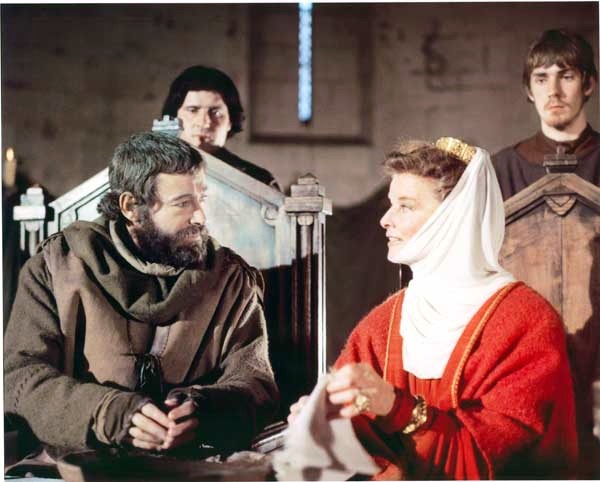
The Lion in Winter concerns the dysfunctional family of King Henry (Peter O’Toole) and his wife Eleanor of Aquitaine (Katharine Hepburn). Eleanor, who has been kept imprisoned in a tower for the past ten years due to her efforts in raising civil war against Henry in the past, has been let out for Christmastide and the visit of King Philip II of France (Timothy Dalton). Due to the death of their heir apparent Henry, King Henry must name a new heir from their three sons, Richard, Geoffrey, and the youngest, John. All of who are vying for the privilege of being the next king. Eleanor favors Richard (Anthony Hopkins), while Henry favors John (Nigel Terry). Poor Geoffrey (John Castle) isn’t considered at all. To complicate matters, the young Phillip is visiting expressly to remind Henry of a treaty he signed many years earlier with his father King Louis (who was once Eleanor’s husband until their marriage was annulled), promising Philip’s sister Alais’ (Jane Merrow) hand in marriage to Henry’s heir. However, Alais has been Henry’s mistress for the past few years, and Henry secretly hopes to marry her off to John but keep her for himself.


 When it becomes apparent that Eleanor and Henry will spend Christmas trying to outmaneuver, scheme and plot for their choices of heir with no consideration for him, Geoffrey begins to plot with King Phillip, planning a war against his father. A plot that will eventually include his younger brother John who ignorantly believes his father when he announces to Eleanor that Richard will be king. Not seeing it for the sneaky maneuver it really is, Henry will discover Geoffrey and John’s plan. Combined with his sudden knowledge that Richard prefers men to women, Henry realizes that he wants none of his sons to be the next king. After much consideration, he decides to annul Eleanor, marry Alais and make new heirs. A tricky maneuver Eleanor immediately pounces on due to Henry’s age, his inability to will Alais to bare sons, and even then, his inability to protect said sons Richard, Geoffrey, and John who would naturally fight for the throne.


The Lion in Winter explores many themes beyond the dysfunctional family such as political maneuvering, love loss, aging, death, and of course, inheritance. Filled with much plotting and scheming, it’s difficult to believe what and who is true or false.


Hepburn, in what I consider to be her best role yet (this is no Hepburn of the 30’s and 40’s here), elicits such sympathy as the independent yet pitiful Eleanor, a woman who still loves her husband but only arouses his passion through anger and insult. Though she manages to tolerate seeing Henry with Alais (a girl she had a hand in raising), her jealousy is translated through civil war against her husband using her son’s rivalry to aid them in committing treason and even possibly, murder.

O’Toole, who continues his reign as Henry II from the earlier film Becket (1964) does so masterfully. In Becket, his Henry is portrayed over a number of years, he is young, impetuous, a serious womanizer, warrior, and lover of all things fun. However, by the end of the film, some of that fire has gone out of him with the death of Becket. In The Lion in Winter, he is much tamer but still has the strength to roar when the situation calls for it- mostly when Eleanor is around. Like when she confesses she slept with Becket and his father. She knows how to goad him, in a way trying to prove there is still love or passion there. There is, making it all the more heartbreaking that they cannot get along better. They have been at war so long, that neither knows a better way to communicate beyond taunts and insults.


Beyond O’Toole and Hepburn, The Lion in Winter also features great acting from newcomers Anthony Hopkins and my long-time crush, the ever-handsome Timothy Dalton (who made a perfectly wonderful 007, in my book). I highly recommend this film. The dialogue alone is quite a treat!

Tonight on TCM!
Featuring director Josef von Sternberg!